


A one-time model drifts
Most clinical models are trained once on historical data and then deployed unchanged. As prescribing patterns shift, patient populations change, and guidelines are revised, a fixed model quietly loses accuracy, and no one sees it happen.
Neonatal nutrition is an unusually moving target. Practice varies by region, there is no single universal guideline, and recommendations are revised as new evidence arrives. A dosing model that cannot move with them degrades exactly where precision matters most.
How we know it holds up
First question, does it match how experts actually prescribe?
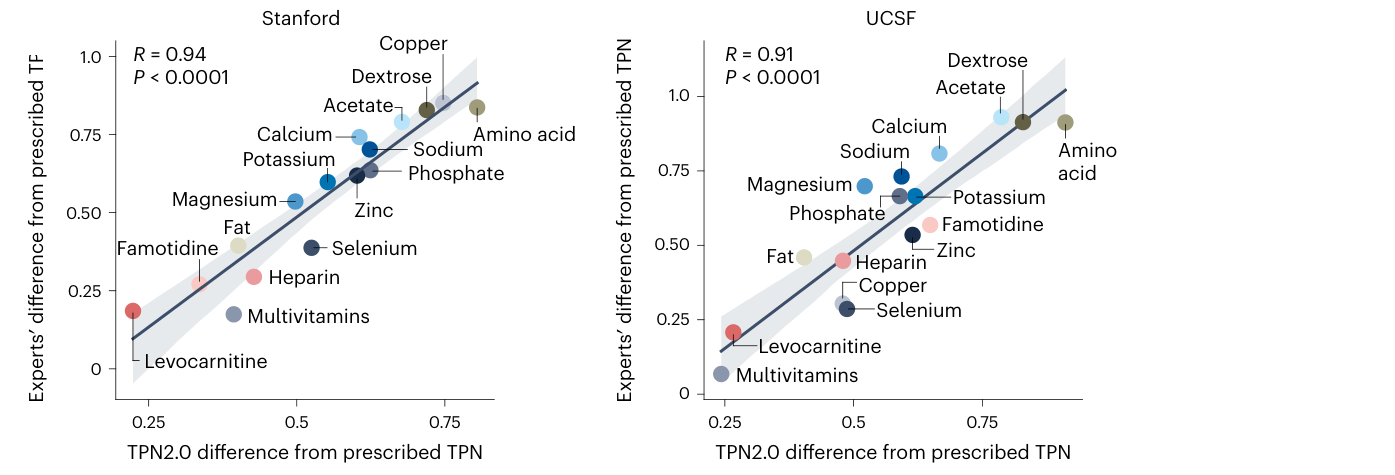
Across every component of the formula, TPN2.0's recommendations tracked what expert clinicians prescribe. And the same held at a second, independent hospital that had no hand in building it. We validated the model there without retraining, and the agreement stayed high.
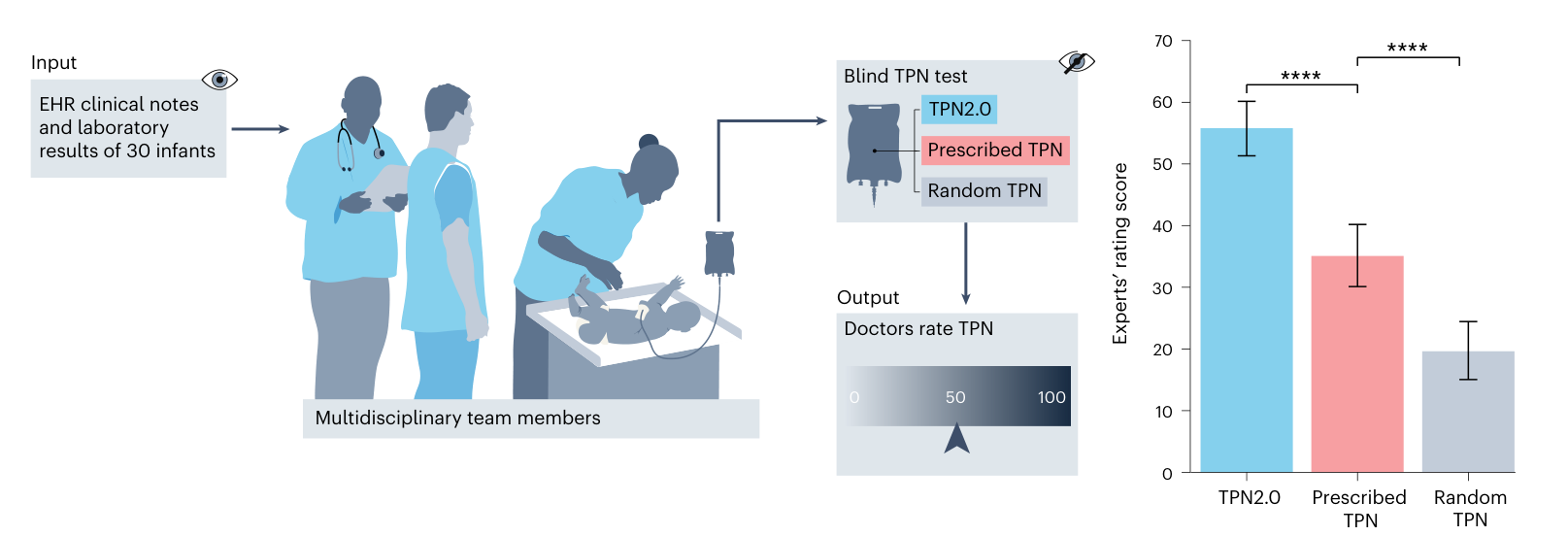
Then the harder test, would clinicians prefer it to today's best practice?
Members of the care team chart-reviewed real NICU patients and blindly rated three formulas, TPN2.0's recommendation, the actual best-practice prescription, and a random one. Across 192 comparisons, they rated TPN2.0 highest, above the prescription the patient actually received.
The model does not stand still
TPN2.0 improves along a continuous cycle. Three inputs feed model optimization, every optimized model is validated before it ships, and only then is it deployed. Then the cycle repeats.

Prescriber-style adaptation
When a clinician adjusts a recommendation, the model can take that adjustment as the next day's starting point and move toward that prescriber's style, always inside the same safety limits. It adapts to the clinician without giving up guideline adherence.
Data-partner aggregation
De-identified datasets from research partners, like the two hospital cohorts in our study, are pooled to retrain and sharpen the model across more populations and sites. This data comes only from consented data partners, never from deployed hospitals.
Guidelines and customization
As ASPEN and institutional guidelines are revised, and as each site sets its own limits and formulary, those rules are folded in, so the model adapts to the standard of care and to the unit it serves.
Adaptation, made concrete
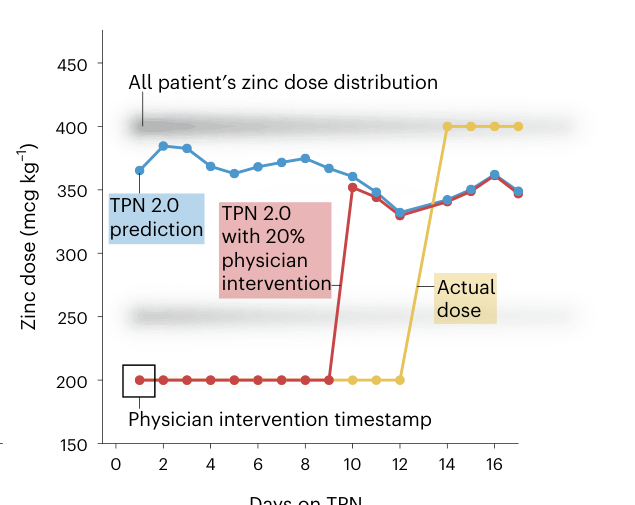
Here the model first suggested a higher zinc dose. A physician overrode it, and TPN2.0 carried that preference forward, holding the clinician's level for the following days rather than reverting. When the clinical picture later shifted, it moved too. The model bends toward the prescriber, within safe bounds, instead of fighting them.
[1] Phongpreecha et al. AI-guided precision parenteral nutrition for neonatal intensive care units. Nature Medicine 31, 1882 to 1894 (2025).